
Costco's 'Quiet Crackdown' of 2026: Why Your .00 Price Adjustment Was Denied

Costco's 'Quiet Crackdown' of 2026: Why Your .00 Price Adjustment Was Denied
You walk up to the membership desk, receipt in hand, confident you're about to get $50 back on that Samsung TV you bought two weeks ago. You saw the price tag on the floor—it ends in .00 now. It's a slam dunk.
Then the manager shakes their head.
"Sorry, we don't price match manager specials."
If this happened to you recently, you aren't alone. I've been tracking retail return data for months, and reports from warehouses across the country confirm a significant shift in how price adjustments are handled as of February 2026. While the written policy hasn't changed, the enforcement has. The era of "automatic" approval for every price drop is fading. It is being replaced by a stricter, data-driven approach that distinguishes between corporate sales and local liquidation.
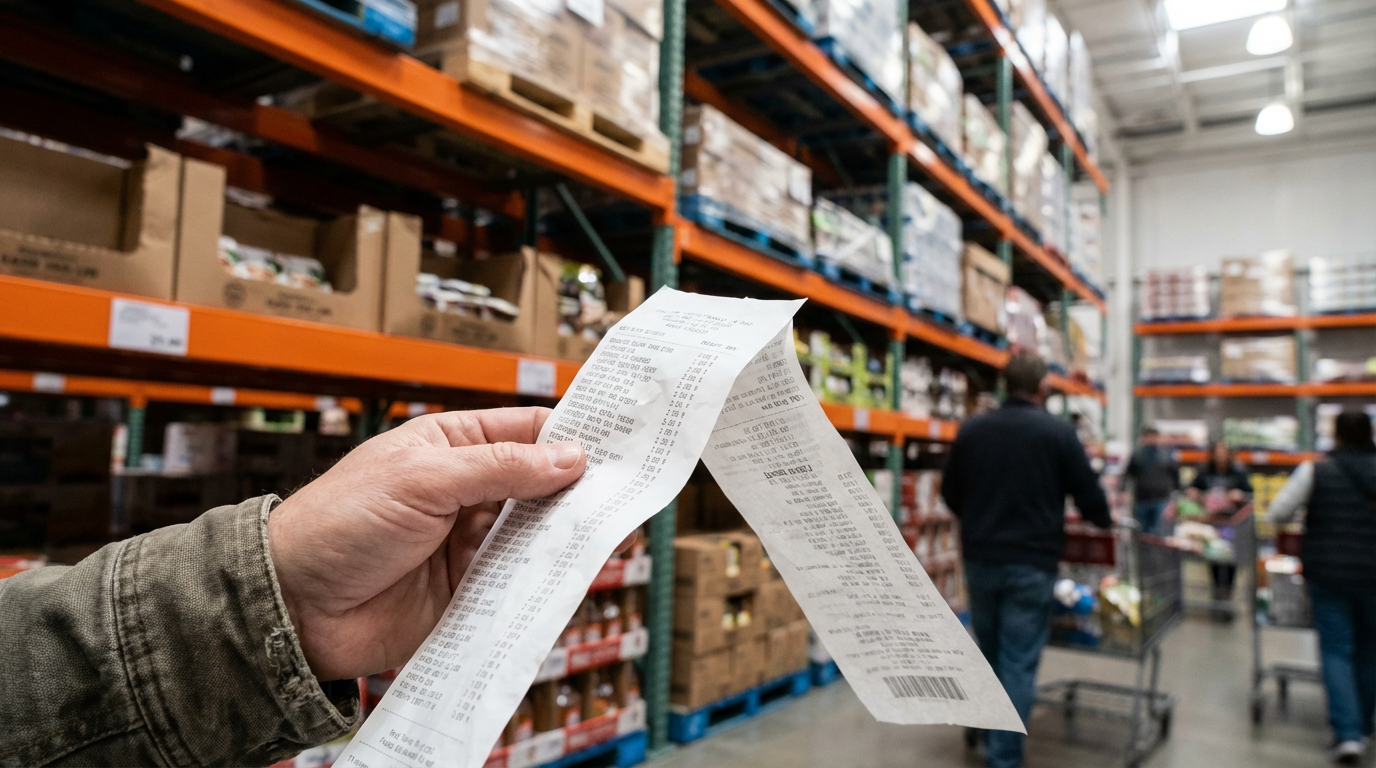
It's a subtle change, but if you look closely at the receipt tape, you can see exactly what is happening behind the counter—and how you can still protect your wallet.
The New Rules of Refunds
The Crackdown is Real:** As of February 2026, Costco has tightened enforcement on price adjustments to combat rising return fraud and costs. .00 Means Final:** Items ending in .00 are "Manager Markdowns" specific to that warehouse. They are now almost universally excluded from price protection policies. Digital Eyes:** Managers now use enhanced tracking tools (similar to The Retail Equation) to flag accounts with excessive adjustment requests. The Loophole:** The only reliable way to get the .00 price is a physical "return and rebuy," but stock levels make this risky.
The February 2026 'Quiet Crackdown'
Retailers are bleeding money on returns—$104 billion annually according to 2026 data from Appriss Retail and Deloitte. Costco is no exception. In response, the warehouse giant initiated what industry insiders call a "quiet crackdown" early this year.
The goal isn't to punish the average member. Costco isn't trying to be the villain here. They are trying to stop "retail borrowing" and arbitrage. But for honest bargain hunters, the collateral damage is a sudden strictness at the returns desk.
Michael Patterson, a retail analyst for The Sunday Guardian, explains the shift: "Enforcement may now be more selective and consistent across warehouses, aiming to balance customer flexibility with financial responsibility. For members, this means the guarantee remains in place — but practical application may feel different."
Translation: The manager has more discretion to say "no" than they did six months ago. And they are using it.
Decoding the .00 vs. .97 Pricing
To understand why your adjustment was denied, you have to speak the language of the price tag. The cents column tells you everything about the item's inventory status.
Standard Clearance (.97) — A corporate-wide markdown. If you buy a blender for $49.99 and it drops to $29.97 next week, you are typically safe. Corporate funded that markdown, so the warehouse doesn't mind giving you the difference.
Manager Specials (.00) — A location-specific liquidation. The warehouse manager in Austin might mark down a pallet of winter coats to clear space, while the Dallas location keeps them at full price. Because these prices are untethered from corporate systems, Costco's internal logic treats them as "final sale" scenarios regarding adjustments.
"If you see an item marked down and its price ends in .97 or in an even .00... then you know it's on clearance," says Marie Clark, a Costco shopping expert at The Kitchn. But while .97 is a structured sale, .00 is a fire sale often applied to floor models or the last few units. The system often blocks the adjustment automatically. This forces the employee to perform a manual override—something they are now discouraged from doing.
The Digital Paper Trail
This is the part that surprises most long-time members. In the past, your purchase history was just a list on a screen. Now, it acts as a dynamic risk profile.
New digital tracking tools implemented at warehouse entrances and service desks in early 2026 allow staff to see return behaviors instantly. If a member frequently requests adjustments on .00 items or returns high-value electronics shortly after purchase, the system flags the account. It isn't just Costco; according to the National Retail Federation, 85% of retailers now use AI to detect return abuse.
According to Colitco, these tools help managers identify patterns of abuse, such as "wardrobing" (buying, using, and returning), which accounted for 60% of fraud cases in recent industry reports. If you are a serial adjustor, the "judgment call" is less likely to go in your favor.
The 'Return and Rebuy' Gamble
So, you bought a sofa for $600. It's now $400.00. The desk denies the adjustment. What now?
Theoretically, you can buy the $400.00 unit, walk out, then immediately walk back in and return it using your old $600 receipt. Or, return your old sofa and buy the new one.
This is the "Return and Rebuy" loophole. It works because Costco's return policy is technically separate from its price adjustment policy.
But there is a catch.
Manager Specials usually apply to the last few units of stock. If you bring your old sofa back, they might not have a new one for you to buy. If you try to buy the new one first, it might be sold out before you get there.
It is a high-risk maneuver. And with the new tracking systems, doing this weekly might put your membership on the radar.
Automation is Your Best Defense
The best way to win this game isn't to fight for .00 adjustments. It's to catch the price drops before they hit that desperate liquidation phase.
Most items hit a standard sale price or a .97 clearance price weeks before they drop to .00. Those standard adjustments are still approved without hassle.
This is where manual tracking fails. You can't visit the warehouse every day to check tags. But tools like CostRefund monitor your purchase history against real-time data 24/7.
When a price drops from $100 to $80 (a standard sale), you get an alert instantly. You claim that $20 immediately. If it later drops to $50.00, you've already secured your savings on the eligible portion, rather than waiting and risking a total denial on the manager special.
As Maurie Backman noted in The Street this month, "Costco is correct to be more stringent... because if it loses a lot of money to bogus returns, it impacts the company's bottom line."
The crackdown is here to stay. Your strategy needs to change with it.
Frequently Asked Questions
Q: Can I get a price adjustment on a .00 item if I speak to a supervisor? A: Rarely. As of February 2026, strict enforcement of the "no adjustments on clearance" rule is the norm. While managers have the power to override, they are under pressure to reduce shrinkage. Unless the price difference is massive or you are a very low-return member, the answer will likely remain no.
Q: How long do I actually have to request a price adjustment? A: Costco's official policy states 30 days from the date of purchase. This is a hard limit. Unlike the satisfaction guarantee on returns, which is flexible, the price adjustment window is fixed. If you miss it by a day, the system will likely reject the request automatically.
Q: Does this crackdown affect the standard return policy? A: Officially, no. Costco still maintains its "Risk-Free 100% Satisfaction Guarantee." However, the definition of "abuse" is tightening. Frequent returns of non-defective items, especially big-ticket electronics, are being scrutinized more closely by the new digital tracking tools to prevent "wardrobing" and arbitrage.
Q: Why does the .00 price sometimes not show up online? A: Manager Specials (.00) are warehouse-specific inventory dumps. They do not exist on Costco.com because they are unique to that single location's stock levels. You cannot price match a .00 in-store price against an online purchase—Costco treats online and warehouse inventories as completely separate entities with different pricing structures.
Q: Will Costco ban my membership for too many price adjustments? A: Unlikely, but they may flag it. While requesting legitimate price adjustments is a member benefit, combining it with frequent returns of .00 items or "return and rebuy" loopholes can trigger a review. The Retail Equation notes that retailers effectively ban ~1% of consumers for behavior that mimics fraud.
Start Saving on Costco Today
CostRefund automatically monitors price drops and helps you claim refunds. Download the app and never leave money on the table again.
Download CostRefund