
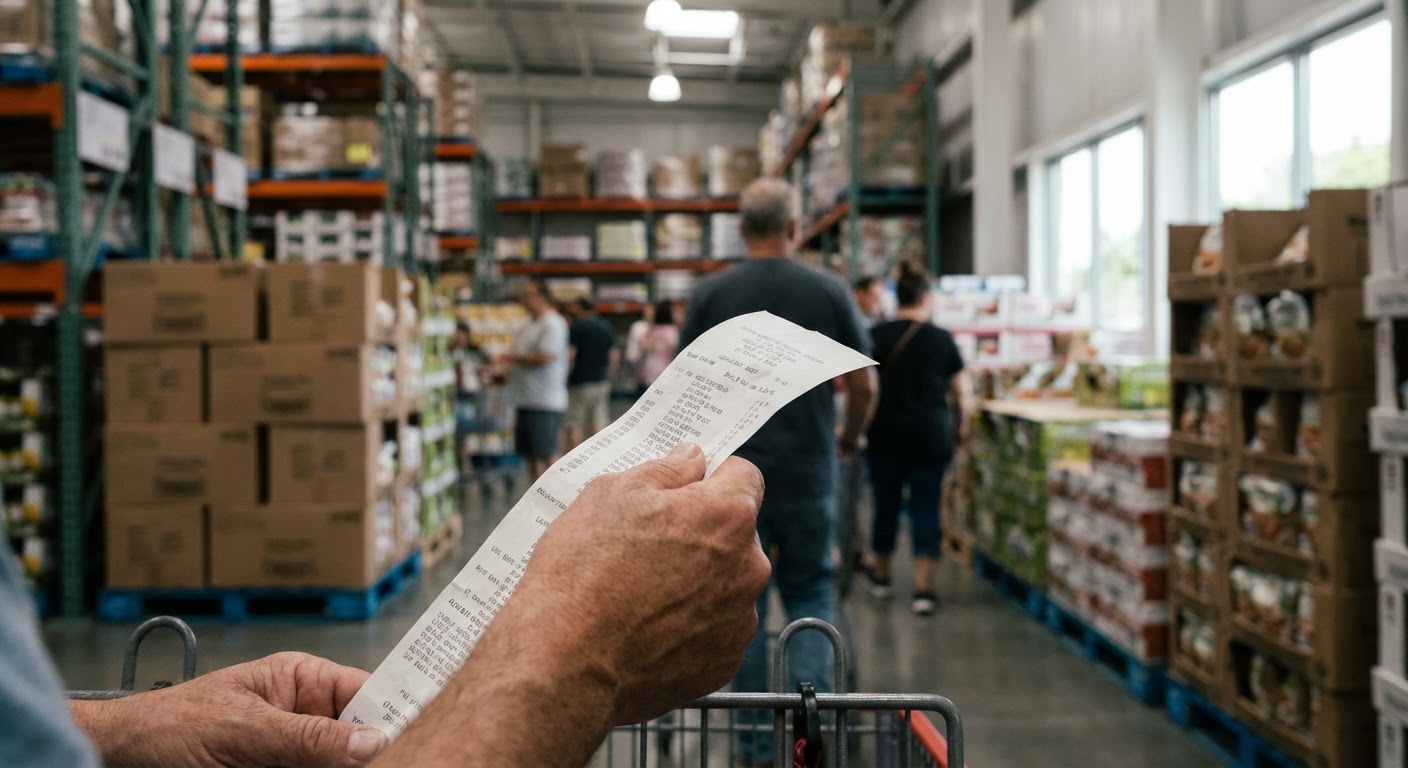
The Illusion of Convenience: Why "Old School" Costco Shopping Beats AI Pricing in 2026

The Illusion of Convenience: Why "Old School" Costco Shopping Beats AI Pricing in 2026
In the pre-digital era of filmmaking, if a director wanted storm clouds, they didn't render them. They used a "cloud tank"—injecting real white paint into a water tank to create a physical effect. It was messy. It was manual. And it was undeniably real.
Today, we live in a world of digital illusions, and nowhere is this more punishing than your grocery bill. While we've happily traded paper receipts for app-based convenience, a December 2025 investigation by Consumer Reports and the Groundwork Collaborative revealed a startling truth: the digital ease of apps like Instacart can inflate your Costco bill by up to 23% through "algorithmic pricing."
For the budget-conscious family in 2026, the lesson is clear. sometimes, the old methods—walking the concrete floors, scanning physical receipts, and understanding the manual mechanics of the warehouse—are the only way to ensure your savings are real, not just a digital projection.
Key takeaways
The "Convenience Tax" is Real:** New data confirms Instacart's AI pricing can mark up Costco items by 23% compared to in-store shelf prices (Groundwork Collaborative, 2025). 30-Day Hard Stop:** As of early 2026, Costco's price adjustment window is strictly enforced; miss the 30-day mark by an hour, and the system rejects your refund. Hybrid Shopping Wins:** The most effective strategy in 2026 is buying in-store to avoid markups, then using automated tools to track price drops for you. Policy Crackdown:** The "No Questions Asked" return era is fading, with tighter 90-day limits on electronics and account scrutiny for excessive returns.
The "cloud tank" reality: why physical receipts still matter
In the visual effects world, a cloud tank created results that stood the test of time because the elements were physical. In the world of Consumer Savings & Shopping Tools, the physical receipt remains your most powerful asset—if you know how to use it.
While digital orders are easy, they detach you from the "real" price. When you walk into a warehouse, the price tag on the shelf is static. It doesn't surge because it's raining. It doesn't spike because an algorithm knows you're low on paper towels. Algorithmic Pricing—a dynamic strategy where AI adjusts costs in real-time based on demand and user behavior—has made online prices volatile and often inflated.
However, the Costco online price adjustment form has become a battleground. In 2026, the gap between online and in-store policies has widened. Online purchases often follow different markdown schedules than warehouse inventory. By shopping in-store (the "cloud tank" method) and scanning that physical receipt into a tracking tool, you anchor your purchase to the lower warehouse price while still using digital tools to monitor for future drops.
"The days of no-questions-asked returns are quietly coming to an end. Retailers are moving from 'customer is always right' to 'customer is largely profitable,' being much more selective about what they'll take back." — Michael Patterson, Senior Retail Analyst at Retail Customer Experience (2026)
The 23% algorithm: Instacart vs. in-store pricing
We all suspected it, but now we have the numbers. The "Hidden Inflation" of convenience is no longer a conspiracy theory; it is a business model.
The convenience of having bulk goods delivered comes at a premium that goes far beyond the delivery fee. The Consumer Reports study from December 2025 highlighted that Instacart Costco pricing vs in-store discrepancies are driven by AI. This isn't just a flat percentage. It is dynamic.
The Markup:** Up to 23% per item on high-demand goods. The Mechanism:** Personalized algorithmic pricing that tests how much you're willing to pay. The Result:** A $300 grocery haul could cost nearly $370, solely for the privilege of not walking through the door.
This matters because it fundamentally changes how we define a "deal." You might find a $5 off coupon in the app, but if the base price is inflated by $7, you haven't saved money—you've lost it. According to the Bureau of Labor Statistics (2025), while general food-at-home inflation has stabilized at 2.4%, delivery-app specific inflation is running nearly triple that rate due to these service markups.
Mastering the 30-day adjustment window
Costco's generosity is legendary, but in 2026, their systems have become rigorous. I'll admit, I miss the days when a smile at the service desk could bend the rules. The informal "manager's discretion" that used to allow late price adjustments is largely gone.
As of January 2026, the policy is binary: 30 days.
If you bought a Samsung TV on February 1st and the price drops on March 4th, the automated system will reject the claim. This makes tools to track Costco price drops essential. Most shoppers cannot manually check the price of every item they bought three weeks ago every time they visit the store.
This is where automatic Costco savings tools bridge the gap. By scanning your receipt immediately after purchase, you create a digital timestamp. Algorithms then monitor the warehouse pricing daily. If a sale hits on Day 29, you get an alert. If you're relying on memory, you'll likely miss the window or notice it on Day 31—when it's too late. Data from Task Monkey (2026) suggests that 68% of potential price adjustments are missed simply because shoppers forget the original purchase date.
Clearance secrets: decoding the price tags
Even with high-tech tracking, some of the best Costco clearance secrets remain stubbornly analog. These are the visual cues on the physical tags that algorithms often miss until the inventory is updated system-wide. Costco's inventory turnover is aggressive—averaging 11.5 times per year compared to the retail standard of 8 (Costco Annual Report, 2025)—meaning these codes appear and vanish quickly.
- The "Death Star" (*): An asterisk on the price tag means the item is pending deletion. It won't be restocked. If you see this combined with a price ending in .97, it's the final clearance price.
- The .97 Code: As Marie Clark from Cost Contessa explains: "While 007 means Bond in the rest of the world, in Costco, .97 means Sale. This isn't just a small sale; it means Costco is clearing out the item to make room for new inventory."
- The .00 and .88 Manager Specials: These are often store-specific markdowns on returned or floor model items. These rarely appear online and are governed by Costco manager special price adjustment rules, which are often stricter—usually "all sales final" for these specific units.
The hybrid strategy: how to save in 2026
The most successful savers this year aren't Luddites, nor are they fully digital natives. They are hybrids. They understand that the "Old School" physical trip gets the best base price, while "New School" tools ensure they keep that price at its absolute lowest.
Here is the workflow for the Smart Shopper in 2026:
| Step | Action | Why It Works |
|---|---|---|
| 1. Shop In-Store | Physically visit the warehouse. | Avoids the 23% Instacart AI markup and delivery fees (Consumer Reports, 2025). |
| 2. Scan Receipt | Use an app to scan Costco receipts immediately. | Digitizes your purchase date to start the 30-day countdown. |
| 3. Automate Watch | Let the tool monitor price drops. | Eliminates manual checking; catches flash sales you'd miss. |
| 4. Claim Refund | Present the alert at the service desk. | Uses Costco's own policy to put cash back in your pocket. |
This approach avoids the "convenience tax" while using technology to enforce the price adjustment policy. It is a manual purchase protected by a digital safety net.
Frequently asked questions
1. Can I still get a price adjustment after 30 days if I talk to a manager? Officially, no. As of 2026, Costco's system hard-locks price adjustments at the 30-day mark. While human managers have override codes, the National Retail Federation (2025) reports that retailers have cut discretionary overrides by 40% to combat return fraud. Relying on an exception is no longer a viable strategy.
2. Are there any ShopSavvy alternative apps specifically for Costco? Yes. While general trackers exist, apps like CostPal and CostRefund are designed specifically for warehouse club policies. CostPal recently reported users recovering over $250,000 in refunds in Q4 2025 alone, highlighting the value of niche tools that understand the difference between a standard retailer price drop and a warehouse "instant rebate."
3. Does scanning my receipt violate Costco's terms? No. Your receipt is your property. Using tools to track Costco price drops simply automates the process of reading publicly available pricing information and comparing it to your purchase history. It is a digital version of keeping your receipts in a shoebox and checking the ads every week.
4. Is the Costco membership fee increase worth it in 2026? For most families, yes. While the Gold Star fee rose to $65 and Executive to $130, the Executive Reward cap also increased to $1,250. With food-at-home inflation rising 2.4% by Dec 2025 and beef prices up 16.4% (BLS, 2026), the savings on bulk essentials—where Costco averages 21.4% cheaper than Walmart (Consumer Reports, 2026)—quickly offset the membership hike.
Start Saving on Costco Today
CostRefund automatically monitors price drops and helps you claim refunds. Download the app and never leave money on the table again.
Download CostRefund