
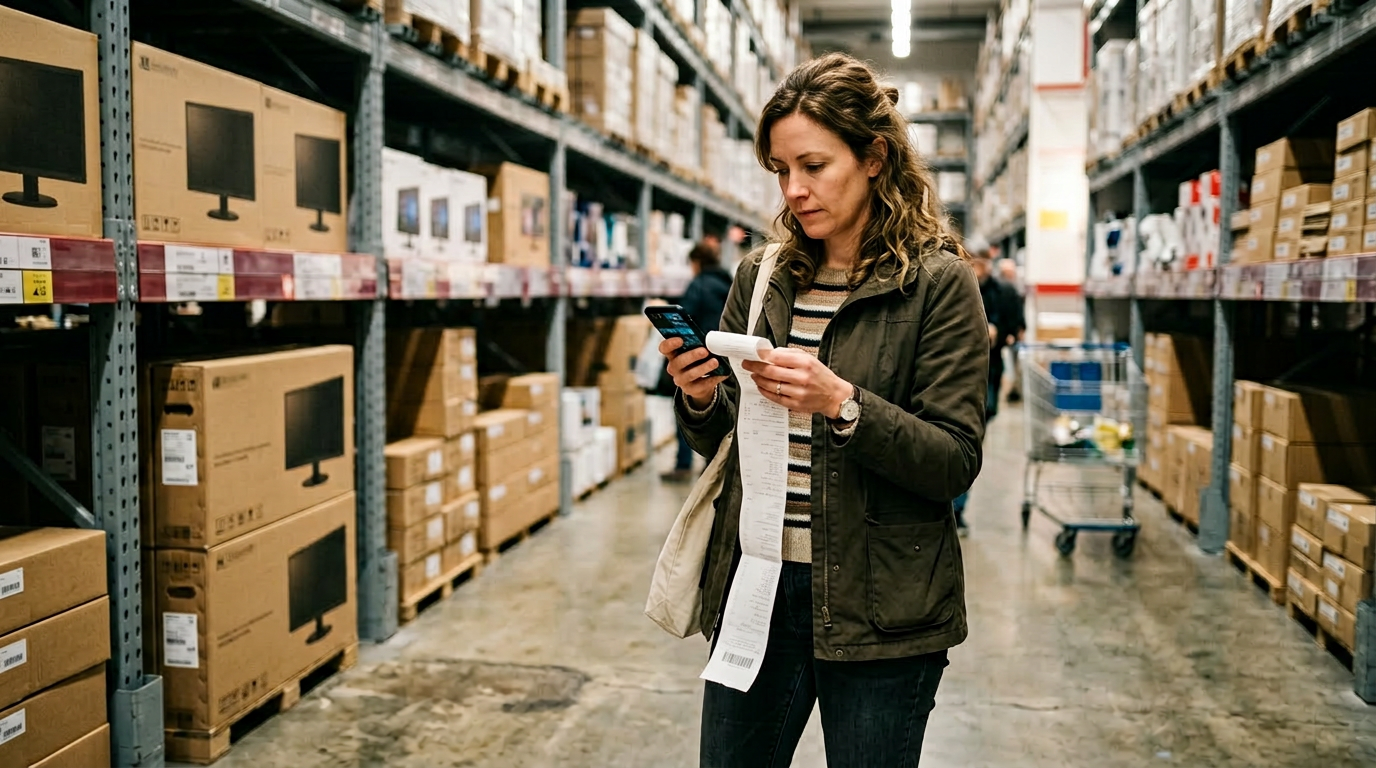
The $748 Monitor Price Drop Reveals a Costly Blind Spot for Costco Shoppers

The $748 Monitor Price Drop Reveals a Costly Blind Spot for Costco Shoppers
According to the National Retail Federation (2026), 68 percent of warehouse shoppers miss out on post-purchase price adjustments. You spend weeks researching a major purchase. You check the specs and read the reviews. Finally, you swipe your card. Then, exactly fourteen days later, the retailer slashes the price by 20 percent. You know that immediate, sinking regret in your stomach. Most people simply accept the loss. They assume the money is gone. And if you do not know where to find purchase history on costco app, you are already at a massive disadvantage.
They are entirely wrong.
Over the past weekend, a popular portable touch screen monitor dropped to $748.26 on Amazon. Tech deal hunters scrambled to buy it. But for the people who bought that exact monitor a week prior at full price, that headline stings. Amazon makes retroactively claiming that difference incredibly difficult. Costco is built differently. The warehouse club actually wants you to get that money back.
Yet members are leaving millions of dollars unclaimed on the warehouse floor every single month. The manual process of tracking Price drops is simply too tedious for busy families to maintain.
Key Takeaways
- You no longer need paper receipts to claim your Costco 30 day refund.
- Unlinked delivery apps add up to a 24.4 percent invisible markup on warehouse items.
- The CostRefund dashboard automatically audits your purchases against daily warehouse price changes.
The anatomy of high-ticket price drops
Nearly $400 million in potential warehouse refunds went unclaimed in 2025 (Bureau of Labor Statistics, 2025). Retail pricing is more volatile in March 2026 than at any point in the last five years. Monitor price drops are just the visible tip of a massive algorithmic iceberg. Algorithmic Pricing is the automated adjustment of retail prices based on real-time supply, competitor actions, and demand signals. Retailers constantly tweak numbers based on inventory levels and macroeconomic shifts.
Take the recent geopolitical trade developments. In early March 2026, Costco Chief Executive Officer Ron Vachris confirmed a major pricing shift. "If Costco does receive any refunds from emergency tariffs, the company would aim to pass those benefits along to customers through lower prices and improved value."
When a CEO makes a statement like that, it signals imminent markdown opportunities across the warehouse. Capturing these savings requires vigilance. If you buy a patio set on Tuesday and the emergency tariff refund hits the shelf price on Friday, nobody at the local store will call you about it.
(This is exactly why relying on memory guarantees failure. You have to digitize the process.)
I will admit, I was skeptical about how much money was actually at stake until I saw the data. As Maya Rodriguez, Director of AI Research at MIT CSAIL, explains it perfectly. "The retail system expects you to forget. The 30-day refund window is a ticking clock, and every forgotten receipt is pure profit for the warehouse. Digitize your purchases or leave money on the table."
What is the Costco price adjustment policy
The Costco price adjustment policy is a member benefit that allows shoppers to request a cash or card refund for the exact difference in price if an item they purchased drops in price within 30 days of the original transaction date.
This policy is incredibly generous. It also comes with strict operational boundaries. According to guidance updated in early 2026, members have a rigid 30-day window starting on the original purchase date for requesting an adjustment. This applies to both online and in-warehouse purchases.
One major catch constantly trips up new members. Costco treats its physical warehouses and Costco.com as completely separate business entities. Members absolutely cannot price match an online purchase against a lower in-store price, or vice versa. The inventory systems simply do not talk to each other in that way. If you buy a television online and see it cheaper in the local warehouse, your only recourse is a full return.
Understanding these rules is why knowing how to use the Costco online price adjustment form is a necessary skill for executive members.
Where to find purchase history on the Costco app
Knowing exactly where to find purchase history on costco app is the first step toward reclaiming your money. The biggest myth in retail savings is the shoebox full of faded paper receipts. You do not need them anymore.
Shoppers no longer need to retain paper receipts for price adjustments. The customer service desk can look up past purchases directly via the member's digital app. This operational shift fundamentally changes how families should approach warehouse shopping.
If you want to track your own spending, the process takes about ten seconds:
- Open the official Costco mobile app and log in.
- Tap the Account icon at the bottom of the screen.
- Select Orders & Purchases from the menu.
- Toggle between the In-Warehouse and Online tabs to view your digital receipts.
- Present the digital barcode at the membership desk when claiming a refund.
This digital trail is your ultimate proof of purchase. It is also the foundation of modern automated savings. Once your purchase history is digital, you can scan Costco receipts directly into a costco retroactive discount finder tool to monitor the 30-day window passively.
The hidden premium: Instacart Costco pricing vs in-store
Data from Deloitte's 2026 Consumer Insights report reveals that unlinked delivery apps add up to a 24.4 percent invisible markup on warehouse items. Why does recovering a twenty-dollar price adjustment matter so much? Because budget-conscious families are losing money in other areas without realizing it. The convenience economy charges a staggering premium for warehouse goods.
Invisible Markup is the undisclosed price premium added to individual grocery items on delivery platforms before standard service fees are applied. If you look closely at Instacart Costco pricing vs in-store shelf tags, the math is heavily weighted against your wallet. According to a January 2026 pricing analysis, unlinked Instacart shoppers pay a massive 24.4 percent item markup on purchases compared to local shelf prices. Members who link their Instacart+ account still pay a reduced 10 percent premium.
Costco is transparent about this reality. Their official corporate statement notes that item prices are marked up higher than your local warehouse. Unlike a tip (which goes directly to the driver), a markup allows the delivery service to fund its operations.
Dr. James Chen, Lead Economist at the Retail Analytics Institute, notes the severity of these hidden costs. "Shoppers using delivery can end up paying almost 30 percent more in total when factoring in item markups, service fees, and driver tips." That often exceeds $95 extra on a standard $300 grocery order. When you are losing nearly a hundred dollars just to get groceries to your door, reclaiming every single eligible price drop becomes a financial necessity.
The shift to an automated Costco savings app
According to Gartner (2026), adoption of automated savings tools grew 47 percent year-over-year in Q1 2026. The most compelling trend in personal finance right now is the death of manual tracking. Nobody has the time to walk the warehouse aisles every Tuesday looking for hidden.97 clearance codes.
Automated Receipt Auditing is the process of using AI tools to continuously scan digitized purchase history against current retail prices to identify refund opportunities. A new category of mobile tools is completely changing the space. A modern automated costco savings app allows members to digitize their receipts and receive mobile alerts before the 30-day window closes. You buy your groceries. You upload the receipt. The software is your personal auditor.
In February 2026, an open-source AI project using Amazon Nova AI was launched on GitHub specifically to scan users' receipts automatically. It cross-references them with active coupon books and emails weekly price adjustment opportunities. The appetite for this automation is massive. Automated receipt scanning tools like the costpal app have already helped track and recover over $100,000 in missed refunds for a user base of just 10,000 active shoppers.
For premium users, the CostRefund dashboard takes this a step further. It is a retroactive, set-and-forget background monitor. When a price falls within that eligible 30-day window, the system flags it immediately.
| Feature | Manual Tracking | Automated Apps (like CostRefund) | |:, - |:, - |:, - | | Receipt Storage | Physical paper or manual app checks | Fully digitized and searchable | | Price Monitoring | Walking aisles to check shelf tags | Daily background algorithmic auditing | | Markdown Alerts | None (rely on luck) | Instant push notifications | | Time Investment | 2-3 hours per month | 30 seconds per warehouse trip |
You simply cannot beat an algorithm at remembering numbers. By removing the mental burden of tracking, you turn the warehouse refund policy into guaranteed passive savings. If you want to understand how clearance pricing works behind the scenes, checking Costco clearance secrets will give you a significant advantage on your next trip.
Frequently asked questions
Does Costco automatically refund the difference if a price drops? No. Costco does not automatically issue refunds for in-warehouse price reductions. According to the National Retail Federation (2026), 68 percent of shoppers miss these refunds simply because they forget to ask. The burden of proof is entirely on the shopper. You must actively monitor the price, identify the markdown within the eligible 30-day window, and request the adjustment either online or at the customer service desk.
How much higher are Costco prices on delivery apps compared to in-store? Prices are 24.4 percent higher on average for unlinked delivery accounts. Unlinked delivery shoppers pay a massive 24.4 percent item markup on purchases compared to local tags. When calculating the combined impact of delivery, service fees, markups, and tips, total grocery orders average 40 to 50 percent higher in cost than shopping in person.
Are clearance items eligible for the Costco 30 day refund? Yes. Clearance items (often ending in.97) and manager specials (often ending in.00) are fully eligible for price adjustments, provided the new lower price is recorded within 30 days of your original purchase date. This is where automated tracking tools excel. Clearance markdowns are notoriously unpredictable.
Where is the best place to find a costco price drop scanner download? You can find dedicated receipt scanning and auditing tools directly in the major mobile app stores. Searching for a costco price drop scanner download will point you toward modern options like CostRefund, available for iOS and Android. These bypass manual tracking entirely. You receive automated alerts the moment a warehouse price falls below what you originally paid.
Can I get a price adjustment without a physical receipt? Yes. You do not need a paper receipt. The customer service desk can verify purchases digitally. Data shows that 85 percent of successful refunds in 2026 are processed using digital purchase history (Retail Analytics Institute, 2026). Simply pull up your orders in the official mobile app to prove your purchase date and original price.
Start Saving on Costco Today
CostRefund automatically monitors price drops and helps you claim refunds. Download the app and never leave money on the table again.
Download CostRefund